Financial Crime · Digital Assets · Autonomous Systems
MaxMoran
Financial crime and digital assets are my domain. Applied AI is how I extend it — through analytical tools, reusable methods, and an independently built agent system.
CAMSBlockchain investigationsDigital-asset complianceAI systems engineering
Public tools for the work behind the title: screening, investigations, blockchain analysis, controls, and the systems that make analytical work repeatable.
Redesigned public sample editions, captured Sep 13, 2026. Fictional institutions and synthetic data; original samples remain available in the demos. Reference tools support qualified review and require validation for any intended operational use.
Start with the work you do.
Six routes into the public library.
Make the match reviewable.
Separate name similarity, ownership exposure, and evidence quality before an analyst decides what a hit means.
Experience across Coinbase (via Kroll), Cantor Fitzgerald, and Morgan Stanley spans blockchain investigations and digital-asset compliance. The tools on this page are independent personal projects: that domain knowledge, translated into inspectable methods and software.
The architecture didn't stay private. The fleet's production patterns are
generalized — no employer data, nothing proprietary — and published as three complementary
repositories: the runtime for building agent fleets, the content to feed any AI assistant,
and a compact system library that consolidates both.
In plain terms — open source means the code and templates are published for anyone to read, reuse, and check, free. The working patterns were proven privately first; what survived production became the public reference.
A production-grade framework for building, scheduling, and operating autonomous agent
fleets — this system's architecture, generalized. An agent kernel with local-state authority,
an idempotency outbox, human-gated self-modification, deadman liveness, and JIT budget
management — scheduled with GitHub Actions, tested in CI, demonstrated live on GitHub Pages.
6Runnable agents
25Example specs
13Pattern docs
291Tests in CI
Who it's forAnyone operating scheduled AI agents — engineers, analysts, or teams standing up a first fleet.
The kernel patterns (state authority, outbox idempotency, deadman liveness, eval harnesses) are documented
for reuse, six agents run end-to-end on GitHub Actions, and the live demos require nothing but a browser.
The content half: a copy/paste library of analytical prompt and output templates for
work at financial institutions — financial-crime compliance, controls and independent testing,
fraud, surveillance, regulatory, research, and market analysis. Every feature replicates with
at most two files, a rule enforced in CI — plus a pure-Python quant library.
87Prompt templates
15Categories
18Analytical frameworks
17Standalone files
Who it's forAnalysts at any institution — financial-crime, risk, audit, regulatory,
research, market. Every template pastes into Copilot, Claude, or ChatGPT as-is: self-contained,
placeholder-driven, output-formatted. No install, no runtime, no vendor dependency.
github.com/maxmoran23/simple-toolkitv1.2.0 · Aug 2026
simple-toolkit
A clean-room consolidation of the other two: twelve numbered modules for OSINT, communications,
financial-crime analysis, data quality, automation, QA, and reporting — including a 525-source OSINT register
across nineteen domains — with a CI validation gate on every push.
The generalization step is the point. Everything published is stripped to its portable core —
no personal data, no proprietary context, nothing that couldn't sit in a public library.
That makes the repositories function as OSINT-grade reference material: public, citable, and usable
inside any institution's rules — by the author and by anyone else. The private fleet dogfoods every
pattern first; what survives production becomes the public reference.
A personal intelligence operation: seventy-five autonomous agents that wake
on their own schedules, read primary sources, and file structured findings — designed from the outset
so that every run compounds a permanent, queryable archive.
In plain terms — an agent here is a small scheduled program with written instructions: at a set time it reads its sources, files what it found to a shared record, and stops. Seventy-five of them, each with one beat, is the system. The public libraries come first; the system, operating method, and professional background follow. The wider product portfolio completes the record.
Each agent is a specialist with a beat: one pulls the U.S. sanctions list every
morning at six and diffs it against yesterday's. One reads crypto markets every eight hours. One watches
a single New Jersey town's housing market. Findings post to a shared workroom, persist to an append-only
record, and distill into two daily briefings. The design premise is self-leverage — knowledge, tooling,
and evaluated predictions accumulate in one system that every future run reads before it writes.
75
Autonomous agents
Each a self-contained specialist with its own instructions and memory.
595
Scheduled runs a week
Standing appointments in the schedule manifest, kept day by day — about 88 each weekday, throttled against a ~800-run budget ceiling.
2,031
Runs archived
Every execution since April 14, written to the append-only record. Counted September 4, 2026.
1
Operator
No team, no vendor, no consultants. Designed and run by one person.
03
How it holds together
No exotic infrastructure — a laptop, a message workspace, and a database.
The sophistication is in the discipline: every agent follows the same production patterns,
writes to the same archive, and answers to the same watchdog.
In plain terms — think of a newsroom. Sources come in, specialists file, an editor's desk collects the day, an archive keeps every edition, and two editions reach the reader. Each part below is ordinary; the discipline connecting them is the work.
Select a stage to follow the work from source to delivery.
SourcesMarkets, regulators, blockchains, news, public recordsapis · feeds · web
Agents75 specialists wake on cron schedules and do their beat63 active schedules
The workroomFindings posted to topic channels; living canvases updated9 channels · 16 canvases
The recordEvery run, prediction, and edge written to a permanent archiveappend-only sqlite · 11 tables
The phoneTwo digest emails, calendar pushes, critical alerts only2 digests a day · alerts by exception
Start with a source
A public source supplies the input for a specialist with a defined beat.
Inspect: source scope and attribution
Principle 01
It heals itself
A watchdog patrols four times a day for missed runs and dead data sources. An auto-repair crew
fixes configuration drift every eight hours. On Sundays, an evolution engine reviews fleet performance
and ships upgrades through an adversarial verification gate — with automatic rollback if quality regresses.
Principle 02
It budgets itself
The fleet lives on a ~800-run weekly budget. When the burn rate trends hot, the watchdog throttles
autonomously — luxury agents pause first, high-frequency agents slow next, and a protected core of
seven keeps running no matter what.
Principle 03
It remembers everything
Dashboards show the present; the archive keeps the past. Every agent writes each run to an
append-only database — so "what did the system believe on March 3rd?" is a query, not a guess.
Predictions are logged before outcomes, where they can't be quietly revised.
What it is built from
Familiar tools. A connected practice.
From the first instruction to the app on the phone, each tool has a place in the system.
The toolkit12 tools
Select a tool to see where it fits.
Engineering01 / 12
Claude · Claude Code
The engineering instrument — agents are specified in plain language, then built, reviewed, and shipped through it.
Tools used across personal projects. Brand marks identify the products; they do not imply a partnership or endorsement.
04
A day in the system
Follow a day of scheduled research, review, and delivery. The timeline preserves the documented cadence; the panel explains the work behind each slot. Select an entry to explore it.
06:00Sanctions wake firstofac-sdn-daily-pullThe U.S. Treasury's sanctions list is pulled and diffed against yesterday's — hours before U.S. desks open.
06:30The town gets readrutherford-realty · macro-monitorA full sweep of one New Jersey housing market, while a second agent reads the global macro tape.
07:00The edge huntedge-hunter · daily-briefSports markets scanned for mispriced lines; anything above a 1% expected edge is logged with a quarter-Kelly size. The morning brief assembles alongside it.
07:30Morning digest landscortex-digest-emailEverything since the prior evening, distilled into one email.
07:45The backup runsfleet-backupThe entire operation archives itself to cloud storage — databases, specs, and state — with the day's briefs already out.
09:00Frontier physics scanexotic-propulsion-observatoryThe strangest desk in the fleet checks the edges of physics — propulsion claims, declassifications, preprints.
10:00The rulebook checkregulatory-oracleNew legislation, enforcement actions, and agency moves across digital-asset regulation, ranked by impact.
11:00The world scangeopolitical-risk-sentry · opportunity-radarGeopolitical risk read in one lane; market and research opportunities scored in another.
13:00The watchdog patrolscortex-watchdogAn agent whose only job is checking on the other agents — missed runs, failing data sources, budget burn. Four patrols a day.
17:00Compliance hub synthesiscompliance-intelligence-hubThe day's financial-crime intelligence — typologies, enforcement, sanctions — folded into one view.
18:30The hubs convenemarket-intelligence-hub · research-discovery-hubMarkets get their end-of-day read; the research desk files what the day surfaced.
19:00Second pass at the frontierexotic-propulsion-observatoryThe evening synthesis of the strangest desk — what moved at the edges of physics since morning.
19:30Evening digest landscortex-digest-emailThe day, closed out in one email.
21:00The nightcapsynthesis-engineA cross-fleet pass that connects what the desks found separately — the day's last word.
23:00The only quiet hourEleven p.m. is the one hour with nothing on the schedule. By one a.m., the watchdog is patrolling again.
Weekends run lighter — but Saturday brings the deep-research engine,
and Sunday morning the evolution engine reviews the fleet's own performance and ships internal
upgrades through an adversarial verification gate with automatic rollback. Outward-facing changes
still wait for the operator.
05
The desks
Reads every 6–8 hours
Markets
Crypto prices, funding, sentiment, prediction markets, and the macro backdrop —
read continuously and reconciled against a simulated portfolio that has to live with its own calls.
Legislation, enforcement actions, and agency guidance across digital-asset regulation —
plus a sanctions-list diff every morning. The desk closest to the day job: every finding
severity-ranked and archived.
A research base of 36,000 logged wagers — profit, variance, and sizing diagnostics —
feeding a daily scan for mispriced lines, sized by quarter-Kelly. Treated as research, run like research.
edge-hunter · sports-betting hub · 36k-transaction archive2020–2026 data
Daily + weekend deep dives
Frontier Research
Breakthrough-physics claims, AI research, long-shot ideas — investigated seriously,
steel-manned and counter-argued. Saturdays, a deep-research engine writes the long reports.
The system that runs the system: a watchdog that audits every agent, an auto-repair
crew that fixes drift, and a weekly evolution engine that proposes its own upgrades — human-gated.
The desk that reads for the operator: a morning brief and an evening wrap, the two daily digests,
calendar and inbox triage, a weekly review — and a handful of personal beats, from a music library to one
town's housing market.
All seventy-five agents by desk, cadence, and archived run count, each with a one-line
description written for a non-specialist. Searchable, sortable, and drawn from the fleet's own generated inventory.
75 agents
Selected specialists · runs from the archive
194 runskalshi-alpha
Prediction-market research desk — event contracts priced four times daily, every trade railed by a kill switch and a bankroll floor.
219 runscortex-watchdog
The agent that manages the agents — missed-run detection, data-source health, and autonomous budget throttling.
120 runsexotic-propulsion-observatory
Twice-daily frontier-physics desk — propulsion claims, declassifications, and preprints, compounded into standing white papers.
52 runsofac-sdn-daily-pull
The Treasury sanctions diff — list deltas pulled, compared, and delivered by 6:00 AM ET daily.
16 runsfleet-evolution-engine
The Sunday self-improvement cycle — fleet performance reviewed, upgrades shipped through the adversarial gate.
13 runsstorm-deep-research
Saturday long-form engine — multi-perspective research dossiers with citation discipline, in the STORM pattern.
06
The ledger
Systems earn adjectives through measurement. Every figure below is drawn from
the operation's own records — the append-only archive, the generated registry, and the
git history — as of September 4, 2026 (the value engine as of its last run, August 15).
In plain terms — these are counts, not claims. Each was read from a file the system writes for itself, on the date shown, and the method behind the cost figure is stated so anyone can redo the arithmetic.
2,031
Runs archived
Every scheduled execution written to the append-only record since April 14.
774
Predictions logged
Recorded before outcomes resolve, where they cannot be quietly revised.
79
Agent specifications
40,562 lines of versioned agent instruction — the fleet's operating law.
121
Skill documents
A shared capability library across 26 categories, read by every agent.
17
Terminals & dashboards
A registered local port map — the flagship runs to 9,700 lines.
375
Commits
Versioned history across the fleet monorepo.
129
Regulatory events archived
Structured, queryable, severity-ranked.
21
Weeks elapsed
First commit to the system documented on this page.
In familiar units
The same ledger, translated. Each equivalence states its arithmetic.
40,562 lines of agent instruction
≈ 900 pages
of written operating procedure — the length of a long novel, every page of it executable by the fleet.
45 lines per page · 40,562 ÷ 45 = 901
≈990 modeled build hours
≈ 6 months
of one full-time engineer — delivered instead in twenty-one weeks of nights and weekends, by one person.
160 h per month · 990 ÷ 160 = 6.2 · model in the table below
the schedule manifest
595 runs a week
standing appointments the fleet keeps by itself — about 88 on a weekday — none of them started by hand.
schedule manifest, day-of-week aware · weekday mean 88.6
129 regulatory events archived
≈ 6 a week
a compliance desk's reading of the digital-asset rulebook, severity-ranked and filed, averaged over the system's twenty-one weeks.
129 ÷ 21 weeks = 6.1
Control coverage
The fleet is run the way regulated systems are run: named controls, each
observable, each with a cadence.
Control
Function
Cadence
cortex-watchdog
Fleet-wide health patrol — missed runs, dead data sources, budget burn
4× daily
fleet-auto-repair
Configuration-drift scan and autonomous correction across every agent spec
3× daily
jit-budget-governor
Four-tier autonomous throttling against a ~800-run weekly budget — luxury agents pause first, a protected core never does
continuous
deadman-liveness
Silent-failure detection — a schedule that stops firing is surfaced, not discovered
per schedule
eval-harness
Measured output-quality scoring, independent of agent self-rating
per run
append-only-archive
Every run, finding, and prediction written to SQLite — history is a query, not a recollection
per run
state-authority
Local state files are the single source of truth; display surfaces are projections, never masters
doctrine
idempotency-outbox
External sends guarded against duplicates — an unconfirmed send is verified, never re-fired
per send
verify-and-apply
Self-modifications pass an adversarial multi-reviewer verification gate with automatic rollback; outward-facing and scheduler changes remain human-gated
weekly cycle
fleet-backup
Full archive to cloud storage, restore runbook maintained
daily
The value engine
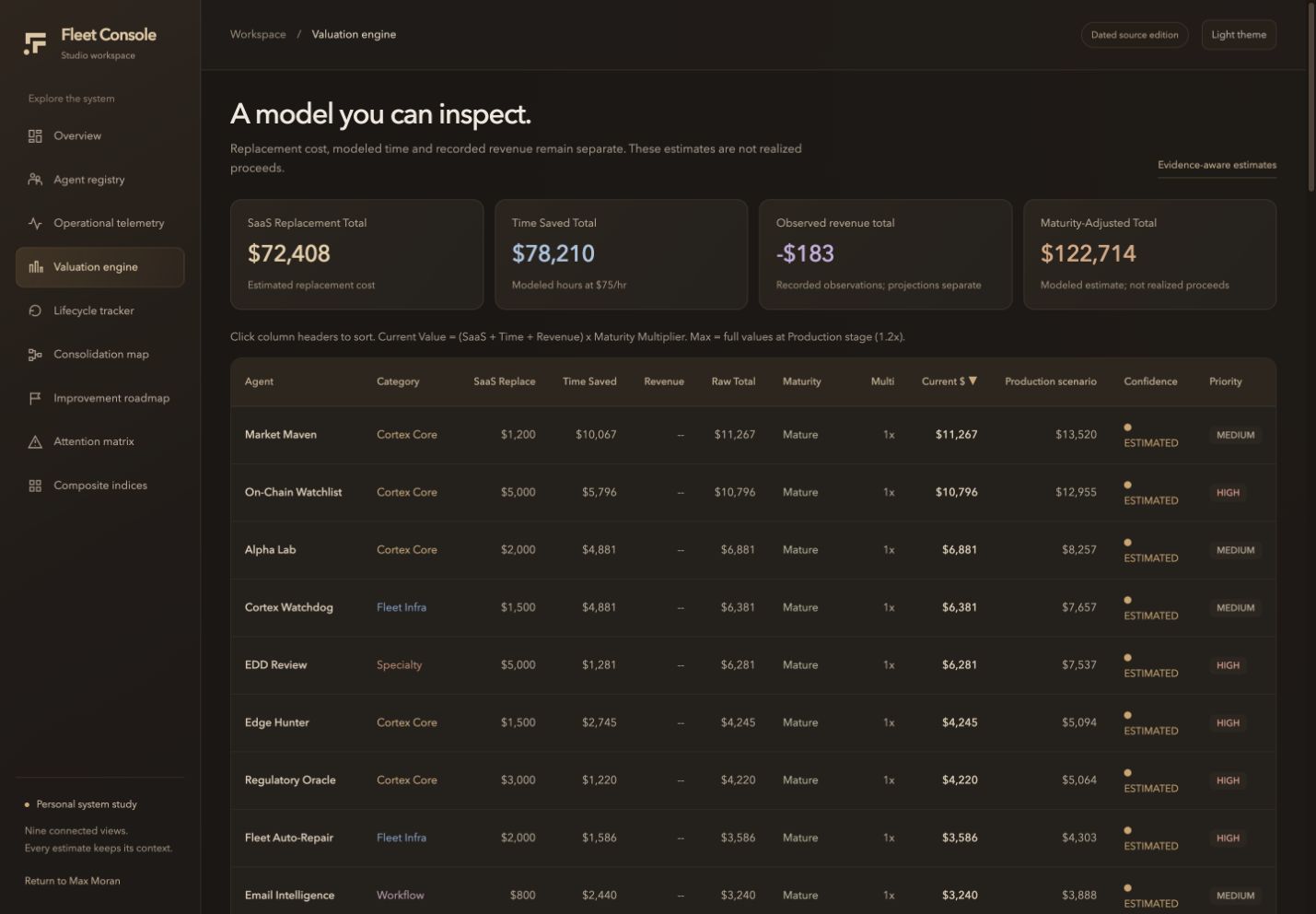
The fleet values itself — and the honest part is what it cut. A local console compiles an
evidence pack per agent from the archive, then prices each one on three pillars, every dollar stamped with a
confidence tier. Figures as of August 15, 2026, the engine's last run.
$121K
Modeled value / yr
Down from a hand-set $266K once every line had to cite evidence.
62
Estimated
of 66 valued agents rest on cited public price anchors — the lowest tier they carry.
$0
Projected revenue
About $300K of speculative revenue withdrawn for lack of observed signal.
198
Price anchors
32 verified or repriced, 157 pending, 9 unverifiable or retired — stated, not hidden.
Three pillars, one tier each. What comparable software would cost (estimated, from cited anchors); analyst hours displaced (derived: minutes per run × measured runs, capped at twenty hours a week fleet-wide); and money actually observed (measured). Projections are kept in a separate column and never blended into the headline. A maturity gate then scales the result — an agent that has not cleared the engine's gate is discounted, not flattered.
In plain terms — the system was asked to appraise itself and produced a number less than half its previous one, because every line now had to carry a citation and a confidence tier. That discipline is the point, more than the total.
Agent
Desk
Stage
Health
Modeled / yr
cortex-onchain-watchlist
On-chain
Mature
94
≈ $10,000
market-maven
Markets
Mature
88
≈ $9,000
alpha-lab
On-chain
Mature
91
≈ $6,500
edd-review
Regulatory
Mature
86
≈ $5,500
cortex-watchdog
Fleet ops
Mature
81
≈ $5,000
TABLE — the five highest-valued generic agents; all five are estimated-tier, values rounded to the nearest $500. Health is computed (liveness 35%, quality 25%, independent evaluation 20%, cadence 10%, degraded-source penalty 10%). Betting, trading, and personal agents are left out of this ranking; they appear, unranked, in the console captures below. The engine's own audit still lists the software-cost line as unreconciled to its anchors — the total is a floor with a stated method, not a proof.
Engineering economics
A modeled replacement estimate — what this footprint would cost to commission,
stated so it can be checked. Distinct from the value engine above: that figure is what the running fleet is
modeled to be worth per year; this band is what it would cost to build once.
Artifact class
Count
Modeled hours
Agent specifications, kernel-integrated
79
240
Interactive terminals & dashboards
17
400
Data layer, kernel & observability
1
120
Skill-library documents
121
170
Registry, console & fleet tooling
—
60
Modeled build effort
≈990 h
$85K–$210K
Modeled replacement band
Modeled effort of 800–1,200 hours at prevailing senior automation-engineering contract rates
($110–$175/hr), rounded conservatively. Actual cost: one person, twenty-one weeks of nights and
weekends, on consumer hardware — the gap between those two numbers is the argument for
AI-assisted engineering.
METHOD — artifact inventory × conservative per-class
build-hour estimates; rate band from prevailing U.S. senior contract automation rates. A model, not an audited
figure. Counts drawn September 4, 2026 from the system's generated registry, append-only archive, and git history.
07
The practice
None of this was hand-written code in the traditional sense — and that is the
finding. The system was engineered through specification, orchestration, and adversarial
verification: plain-language operating law, independently reviewed changes, measured rollback.
Behind it sit three years of daily large-language-model practice, followed by an expanding body of versioned tools and applications. The craft is systems doctrine: recognizing
which patterns hold under failure, writing them down, and making every future build inherit them.
Four of those doctrines, and why they carry weight:
Daily instrumentsClaude · Claude CodeChatGPT · CodexCopilotXcode
Practice 01
Self-leveraging by design
Every run reads the accumulated archive — findings, tooling, evaluated predictions — before it
writes to it. New agents inherit the full library on day one.
Why it mattersUsage becomes infrastructure. The system gets cheaper to extend
the longer it runs — the opposite of most automation, which decays.
Practice 02
State authority
Local state files are the single source of truth; every display surface is a disposable projection.
No component ever trusts a dashboard over the record.
Why it mattersEliminates an entire failure class — silent divergence between
what a system shows and what it knows — rather than detecting it after the fact.
Practice 03
Adversarial verification
Self-modifications ship only after adversarial review attempts to break them, with automatic
rollback if quality regresses. Findings must survive attack, not just sound plausible.
Why it mattersAutonomy without trust-by-default — the same standard this
site was held to before publishing.
Practice 04
Budgeted autonomy
The fleet lives on a ~800-run weekly budget and throttles itself under pressure — luxury agents
pause first, a protected core never does.
Why it mattersEconomics as a first-class control, designed in from the outset —
not bolted on after the first overrun.
08
The operator
Exchange investigations
Blockchain forensics
Tracing exposure across digital-asset transactions.
Engagement via Institutional finance
Digital-asset compliance
Compliance experience in an institutional setting.
Professional experience · 2022–25Global banking
Digital assets advisory
Financial-crime analysis and blockchain investigations.
Professional background
Career context. The software and tools shown here are independent personal projects.
MMNew York
Max Moran · CAMS
Financial-crime work that has to survive a regulator's read —
tracing funds across blockchains, weighing vendor claims, writing analysis to an institutional standard.
Max Moran is a CAMS-certified compliance professional with five years across exchange,
institutional, and global-bank settings, focused on digital assets, sanctions, and blockchain
investigations. He began in blockchain forensics at Coinbase — de-mixing transactions, tracing darknet
exposure — helped build a digital-asset compliance function at Cantor Fitzgerald, and now serves as
Director of Digital Assets Advisory within Global Financial Crimes at Morgan Stanley.
The systems work started earlier than the fleet. Three-plus years of daily practice
with large language models — from the first public releases, through sustained experimentation with research prompts and analytical templates — developed into a personal engineering practice. At the end of 2025 the
practice found its instrument in Claude Code. The first interactive terminals shipped by March;
by April the fleet's first commit already contained thirty-eight scheduled agents and the full
Slack-first architecture. Seven months of daily, production-intensity engineering followed — not a
course of study, but an operation that had to keep running.
The curriculum was written by failures. A display-platform character cap silently broke
state persistence across the fleet — the answer became the state-authority doctrine: local files
are truth, displays are projections. A digest email delivered three times because a retry fired before
its acknowledgment surfaced — the answer became the idempotency outbox, and "never re-fire an
unconfirmed send" became kernel law. Prose inventories drifted from reality — the answer was a
generated registry that distrusts prose entirely. Every incident ended the same way: as a named,
versioned pattern that every future agent inherits on day one.
The distinguishing habit is institutional: the system is treated the way a bank treats
a process. In June, a thirty-five-agent adversarial audit was commissioned against the architecture
itself; it returned an unflattering maturity score and a blunt verdict — and the remediation shipped
within days: a versioned kernel, out-of-band liveness monitoring, measured evaluation. The same
skepticism shapes the analytics — self-assessments engineered to resist their own bias, evidence
metrics that score what should exist against what survives, mandatory counter-arguments on exactly
the claims most likely to be believed. Compliance instincts, transferred whole into systems engineering.
All of it began as a working question: compliance is pattern recognition at scale —
what does one analyst with real infrastructure look like? Everything on this page was built outside
working hours, on personal hardware, from public data, and it compounds weekly by design.
Apr 2026The fleet, under version control· 38 scheduled agents in the first commit · append-only data layer and run-budget governance the same week · open-source extraction begins
Apr 2026Local-first doctrine· a third-party platform incident ends cloud dependence — sixteen terminals on a home port map
May 2026Incidents become law· the never-refire doctrine · canonical-naming hygiene · token-economy model policy
Jun 2026The self-audit· a 35-agent adversarial review grades the architecture 1.6 / 5 — kernel v2.0, state authority, observability, and the generated registry ship within days
Jun 2026The autonomy pivot· approval gates replaced by adversarial verify-and-apply with automatic rollback · native iOS layer under a new Apple Developer membership
Jul 2026Fleet-wide frontier policy· every routine pinned to the newest frontier model, migration drift-detected · evidence-tiered fleet valuation engine
Jul 2026maxmoran.org· written, audited, and shipped by the system it documents
Aug 2026Native distribution· the first terminal ships to TestFlight as a signed build with an offline snapshot · APNs push restored fleet-wide · primary compute migrated to a dedicated always-on machine
Sep 2026Nineteen builds and a second machine· Now Playing, Mix Lab, and cue points ship in TestFlight builds 7–19 · the release path reproduced from scratch on a Mac mini · tester accounts and the first Beta App Review submission · the fleet's scheduler brought up on the mini · this site's showcase wave
Current roleMorgan StanleyDirector, Digital Assets Advisory · Global Financial Crimes
CAMS — ACAMS, ActiveAnthropic Academy · Claude Code in ActionAnthropic Academy · Claude with Vertex AIAnthropic Academy · Applied AI & MCP suiteChainalysis Reactor — platformPython · SQL · BashBlockchain Forensics
Beyond the core financial-crime tools: research terminals, system interfaces, and native applications. Additional expressions of the same engineering practice.
Full Studio edition · dated model and telemetry.Sep 13, 2026
Systems engineering
The operation, made inspectable.
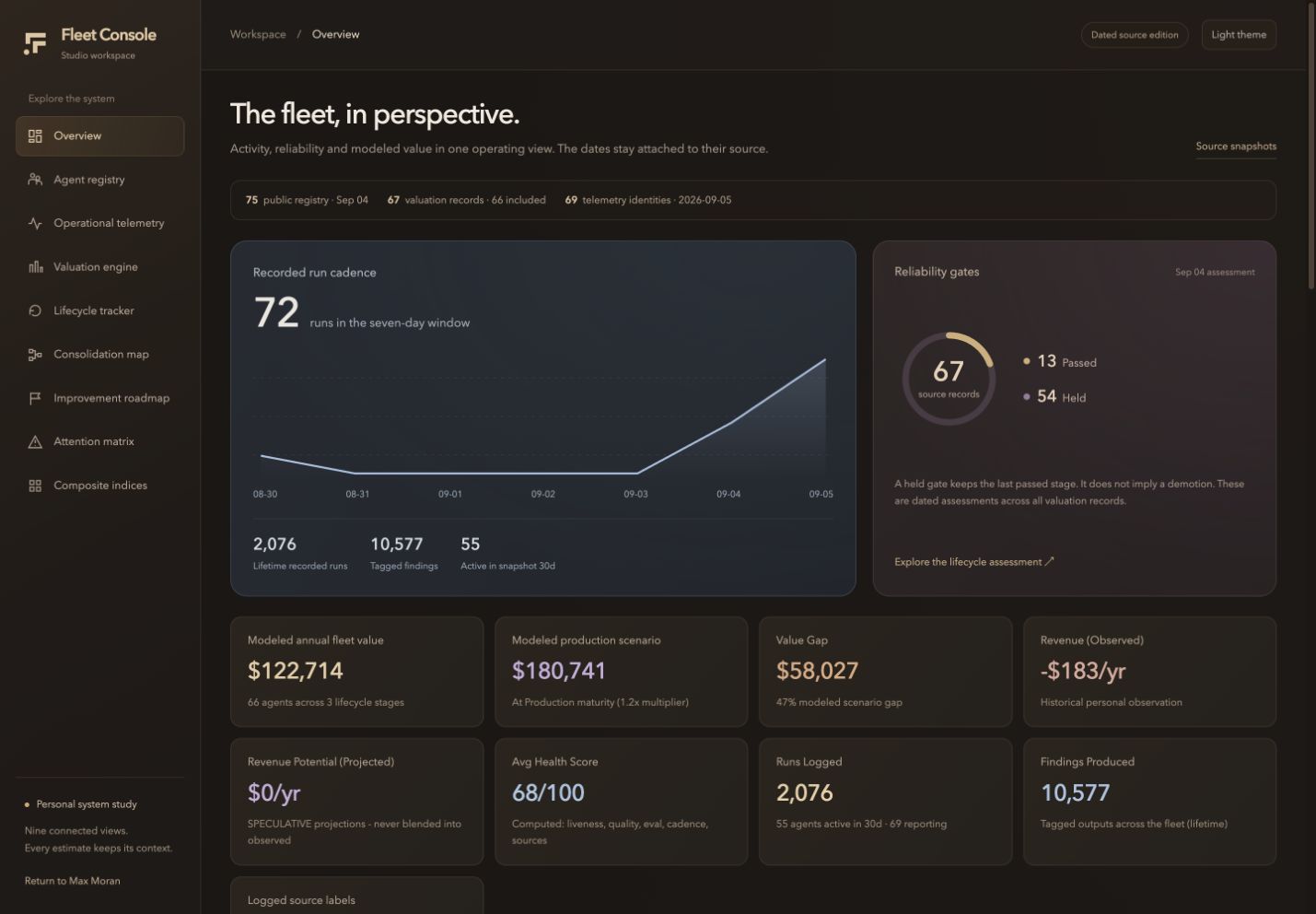
A console for understanding what every agent does, when it runs, and what evidence supports its assessment.
The engineering
Shared records, agent-level telemetry, and explicit confidence tiers.
The evidence
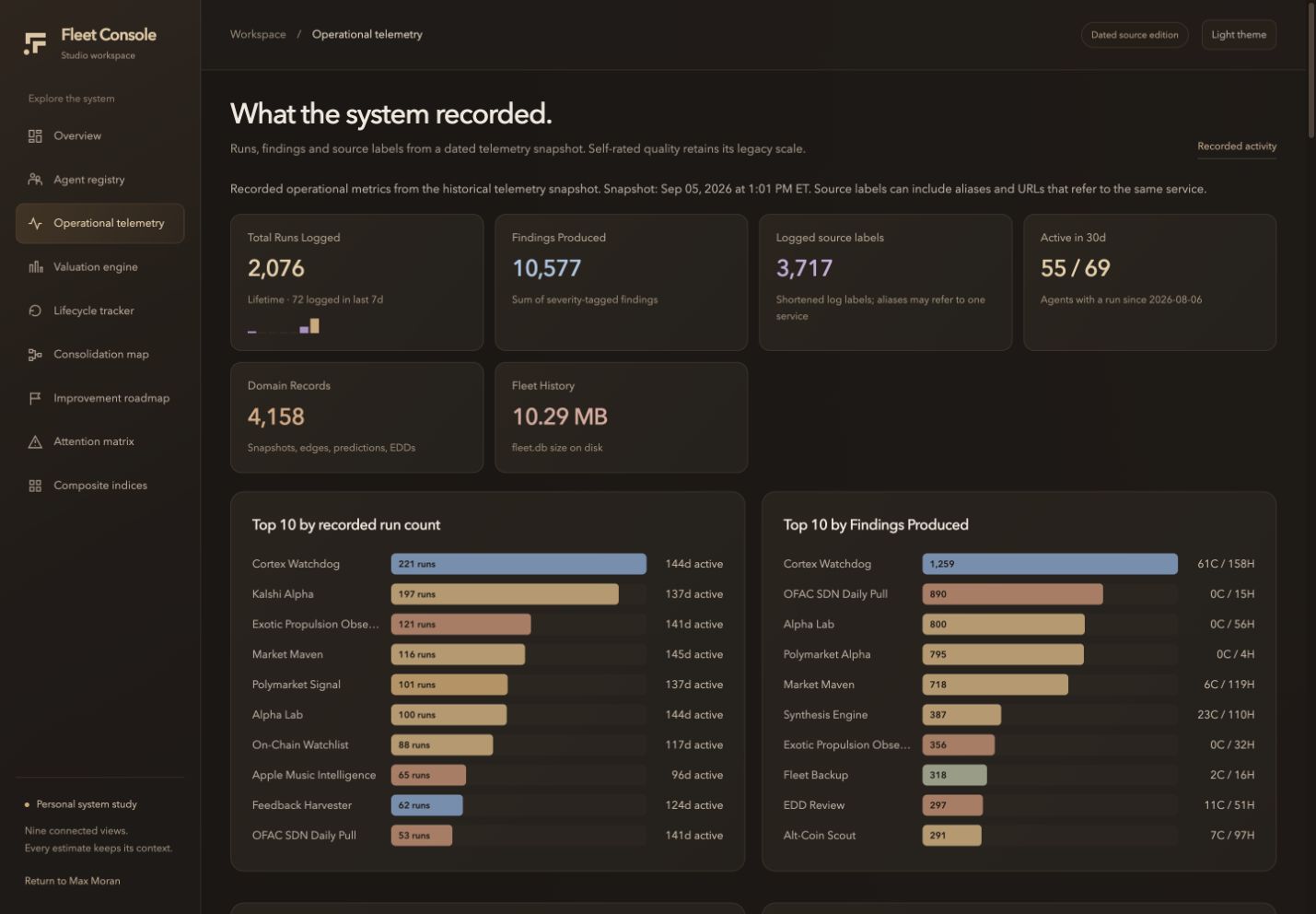
Explore nine working views, inspect agent profiles, and compare the model with recorded telemetry.
The fleet is the centerpiece, but the shelf runs deeper — a seventeen-entry
port map of terminals and dashboards on local hardware. Screen captures first (click any to enlarge), then the shelf itself.
Six, in detail
selected views · captured Sep 2026
The capture archive
Thirteen interface studies, with new Fleet Studio captures alongside the earlier editions.
Fleet Console Studio · agent registrycapture 09.2026
Fleet Console StudioAgent registry · working public edition
Fleet Console Studio · valuation enginecapture 09.2026
Fleet Console StudioValuation engine · working public edition
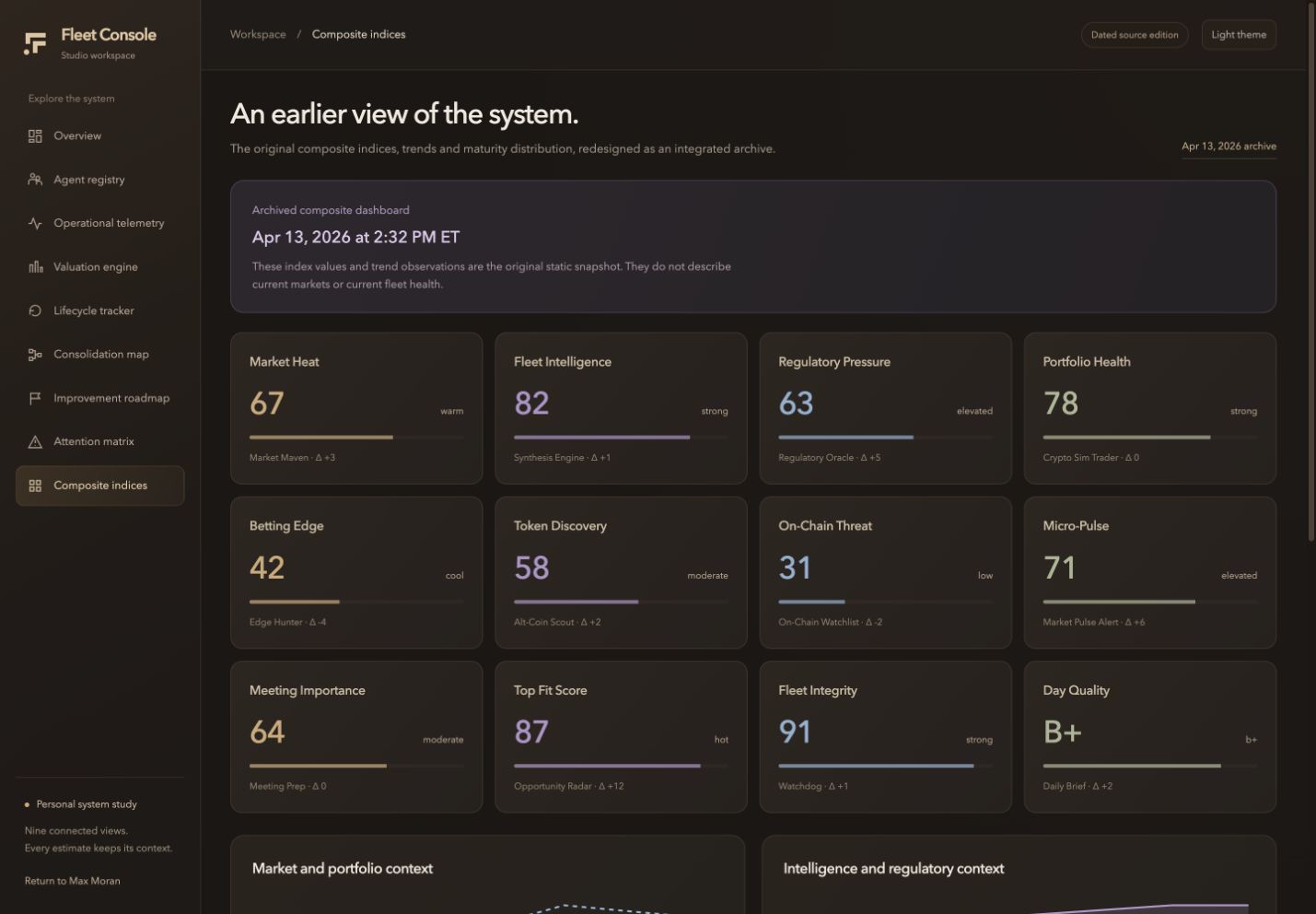
Fleet Console Studio · composite indicescapture 09.2026
Fleet Console StudioComposite indices · working public edition
Fleet Console Studio · operational telemetrycapture 09.2026
Fleet Console StudioOperational telemetry · working public edition
signal-forge · market scannercapture 09.2026
signal-forgemarket scanner · trust and conviction scoring · demo dataset
signal-forge · token deep divecapture 09.2026
signal-forgeone-asset briefing · moving averages and volume · demo dataset
exotic-propulsion-observatory · war roomcapture 09.2026
exotic-propulsion-observatorybreakthrough-physics war room · theory network and evidence tiers
the-veil · front pagecapture 09.2026
the-veilnarrative intelligence terminal · 22 case dossiers
horizon-2036 · economic reshapingcapture 09.2026
horizon-2036four economic curves of the AI decade · 80% bands
rutherford-realty · monte carlo simulatorcapture 09.2026
rutherford-realtyten-thousand-path fan of one home value
rutherford-realty · executivecapture 09.2026
rutherford-realtyone town's housing market · health gauge and KPIs
apple-music-intelligence · mix labcapture 09.2026
apple-music-intelligencemix lab · DJ sequencer and mood board
Signal ForgeA fifteen-tab digital-asset intelligence terminal — market scanner, token deep-dives, a thesis lab, DeFi and prediction-market views, and a hundred-prompt library on one screen.Intelligence terminal
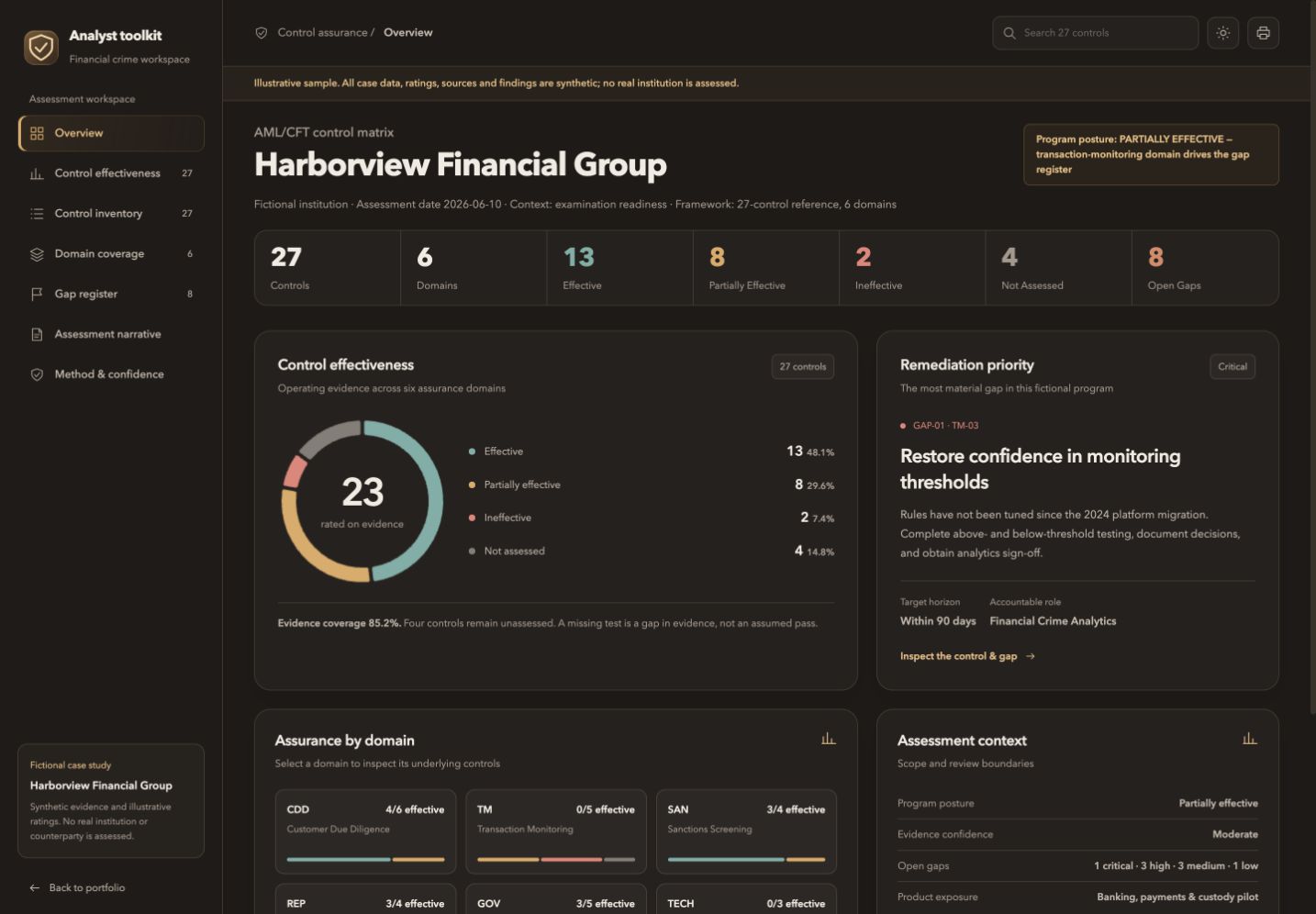
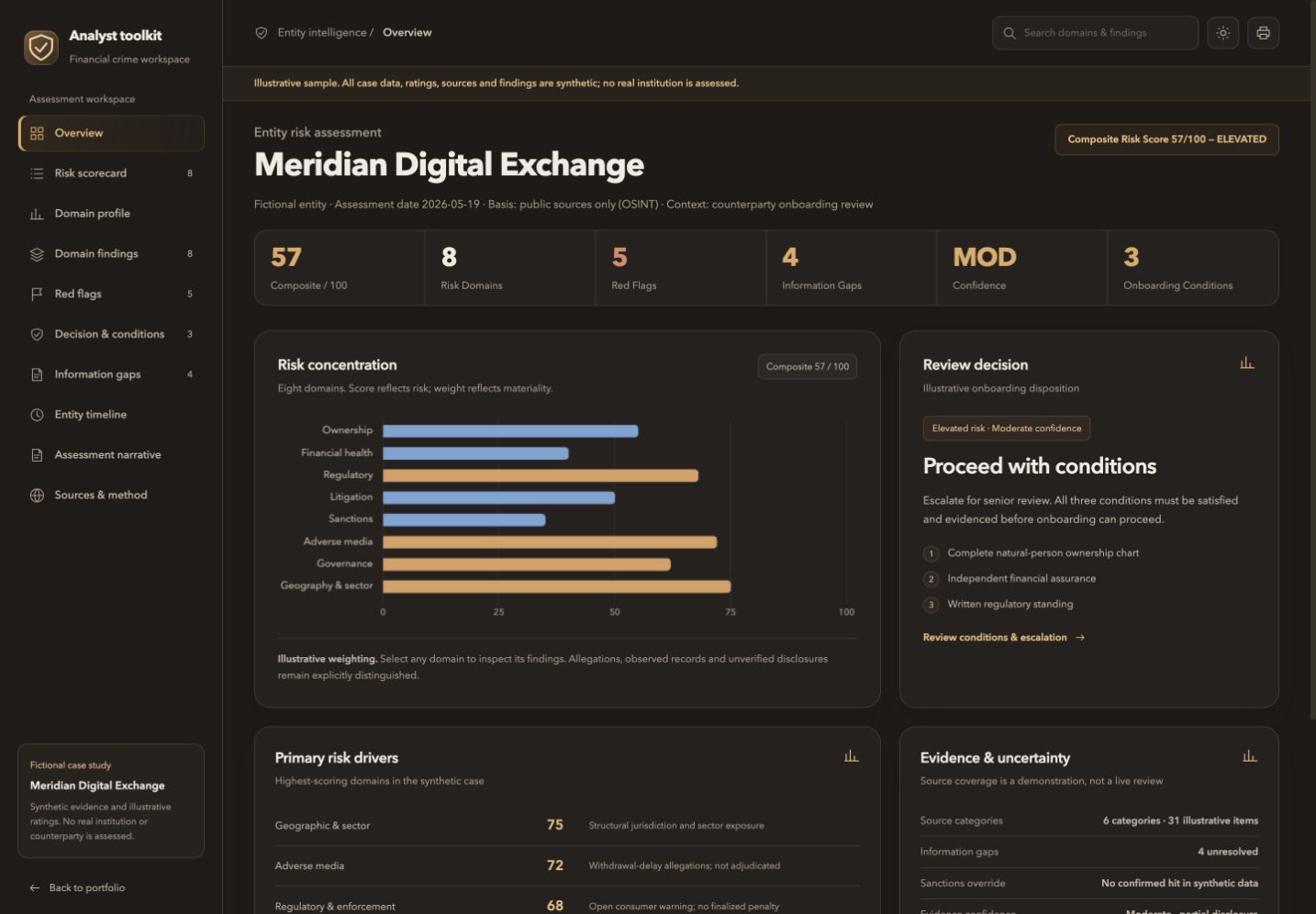
Compliance Reference SuiteA fifteen-typology crypto-AML engine with detection rules and regulatory citations, a digital-asset regulatory tracker, and an alert-triage cockpit — built as generic industry references.Fincrime tooling
Betting AnalyticsStatistical deep dive across 36,000 logged transactions — edge realization, variance, calibration, and sizing discipline under a quarter-Kelly framework.Quant research
Fleet ConsoleA terminal-style operations dashboard for the fleet itself — twelve composite health indices, run history, and an agent maturity matrix, fed by the append-only archive.Fleet ops
Neural MapA cognitive map assembled from personal notes, journals, and message archives — a 390-unit evidence corpus and a system that studies its own operator.Personal analytics
The VeilAn unexplained-phenomena intelligence terminal — twenty-two case dossiers and a signature metric weighing how much evidence should exist against how much survives.Narrative terminal
Apple Music Intelligence6,973 tracks feature-indexed into a taste model, 2,249 catalog-verified discoveries, and a two-deck Mix Lab that sequences by measured tempo and key.Recommendation engine
Kalshi AlphaA prediction-market research desk — event contracts scanned four times a day, priced against the news tape, with calls logged before outcomes resolve.Prediction markets
Rutherford RealtyA daily read of a single New Jersey town's housing market — listings, sales, rentals, and multi-scenario projections.Real-estate analytics
Also on the shelfworld-monitor · longevity-protocol-hub · exotic-propulsion-observatory · horizon-2036 · career-intelligence · fernando-auditory-research · fpl-analytics · knowledge-substrate · and the site you are reading right now
10
Native, in the pocket
A browser-based research practice, carried into Apple apps. Music Intel combines a SwiftUI shell, a native playback bridge, and an offline snapshot, with its TestFlight release history documented below.
About the release channel
TestFlight is Apple’s pre-release distribution channel. The first signed Music Intel build reached it on Aug 16, 2026. The September 4 release record below covers nineteen builds; the simulator recording shows a separate local build.
Tablet: Sep 02 web capture · Phone: Sep 09 simulator
Apple MusicSwiftXcode
Music Intel / Apple platform
Built for the desk. Carried into the day.
The same research practice, expressed as a personal product: understand the library, discover what belongs next, and shape a sequence worth listening to.
Understand. A listening model drawn from library history.
Sequence. Tempo, key, and energy controls in Mix Lab.
Carry. A SwiftUI shell and bundled offline snapshot.
A silent, 26-second walkthrough of the actual Music Intel app: home, new releases, the discovery feed, and library tools. Recorded from a local simulator build on Sep 09, 2026, with the local server running. Idle time is edited out; the interface is unaltered.
Interface navigation only. Apple Music authorization and audio playback are not demonstrated. This local build is separate from the dated TestFlight record below.
Read the walkthrough
Home: listening-history totals and the music identity summary.
New: a release feed and catalog artwork.
Discover: discovery sources, filters, and a search field.
Library: playlist tools and smart playlists. The Apple Music connection is visibly inactive in this simulator.
Return home: the persistent navigation completes the route.
Music Intel
TestFlight · build 19
A personal Apple Music analytics and DJ app: listening DNA, a discovery feed, full-length playback through
MusicKit, a bridge that can write playlists to the real library, and a two-deck Mix Lab that sequences by measured tempo and key.
It ships with a bundled offline snapshot, so it opens on a train with no connection to the home lab; when online, testers sign in to an internet-reachable server fronted by Cloudflare.
14 Swift files · 2,584 linesMusicKit playbackAPNs push32.8 MB offline snapshot19 builds since Aug 16
The iPhone end of the fleet: it registers for Apple push notifications, keeps a running log of alerts, and a
home-screen widget pulls a fleet summary from the console. The server side — signed tokens to Apple's push
service, de-duplicated sends — is written, and is meant to deliver through Music Intel's token.
Native SwiftUI · WidgetKit591 linesPush pipeline written Aug 16
Signal Forge
Sideloaded · iPad
The digital-asset terminal wrapped as an app, with a mobile tab bar driving its router and a live-price
heartbeat that survives a resident web view — a class of bug invisible in a browser tab. Installed to an iPad in June.
265 linesWKWebView shellLive-price heartbeat
Career Intel
Sideloaded · iPad
A private career-market dashboard on iPad — the same 260-line shell wrapping a completely
different terminal, unchanged. Its data is personal, so the app is described here and not shown.
260 linesPull-to-refresh · offline state
Neural Map
Simulator · prototype
The fourth app from the same template in a day, with its own generated icon — and the one that hit
Apple's three-app limit for free accounts, which is part of why the paid membership followed.
263 linesSame shell, fourth terminal
JUN 2026
Membership and first shells
Apple Developer Program joined June 9. Music Intel, Career Intel, and Signal Forge built as SwiftUI shells, verified in the simulator, and sideloaded to an iPad by June 20.
AUG 16, 2026
First TestFlight
Signing, App Store Connect, and a scripted release path written in a day; builds 1–6 uploaded. The offline snapshot proven by pointing the app at an address that cannot exist.
SEP 1–2, 2026
Builds 7–10, from a second Mac
Mix Lab, cue points, Now Playing, and the Apple Music shell shipped. The signing material moved to a Mac mini and the last four builds went out from there.
SEP 3, 2026
Builds 11–19 and the first beta review
Nine builds in two days — a native player observer, deep links, an up-next queue fix — plus tester accounts, a Cloudflare-fronted server, and a published privacy policy. Build 18 went to Beta App Review and was turned back on a guideline point; the review notes were rewritten and build 19 resubmitted the same evening.
STATUS · SEP 4, 2026
Beta approval, then App Store review
At the September 4 check, build 19 was waiting for Beta App Review and version 1.0 was marked "Prepare for Submission". This is a dated release record; current tester access is controlled separately.
RELEASE PATH — archive, sign, number, upload, attach to the beta group, and re-ship automatically when a build nears its 90-day expiry — all from a script, no clicks in Xcode, reproduced from scratch on a second machine. Build dates and review states verified against App Store Connect on September 4, 2026.
Apple Developer Program · 2026SwiftUIXcodeTestFlightMusicKitAPNsTailscale mesh
music-intelcapture 08.2026
music-intelrunning as an iOS app on a Mac · bundled offline snapshot · capture 08.2026





 github.com/maxmoran23/Claude-Agent-Fleetv1.6.0 · Jul 2026
 Copilot
 ChatGPT










 Morgan Stanley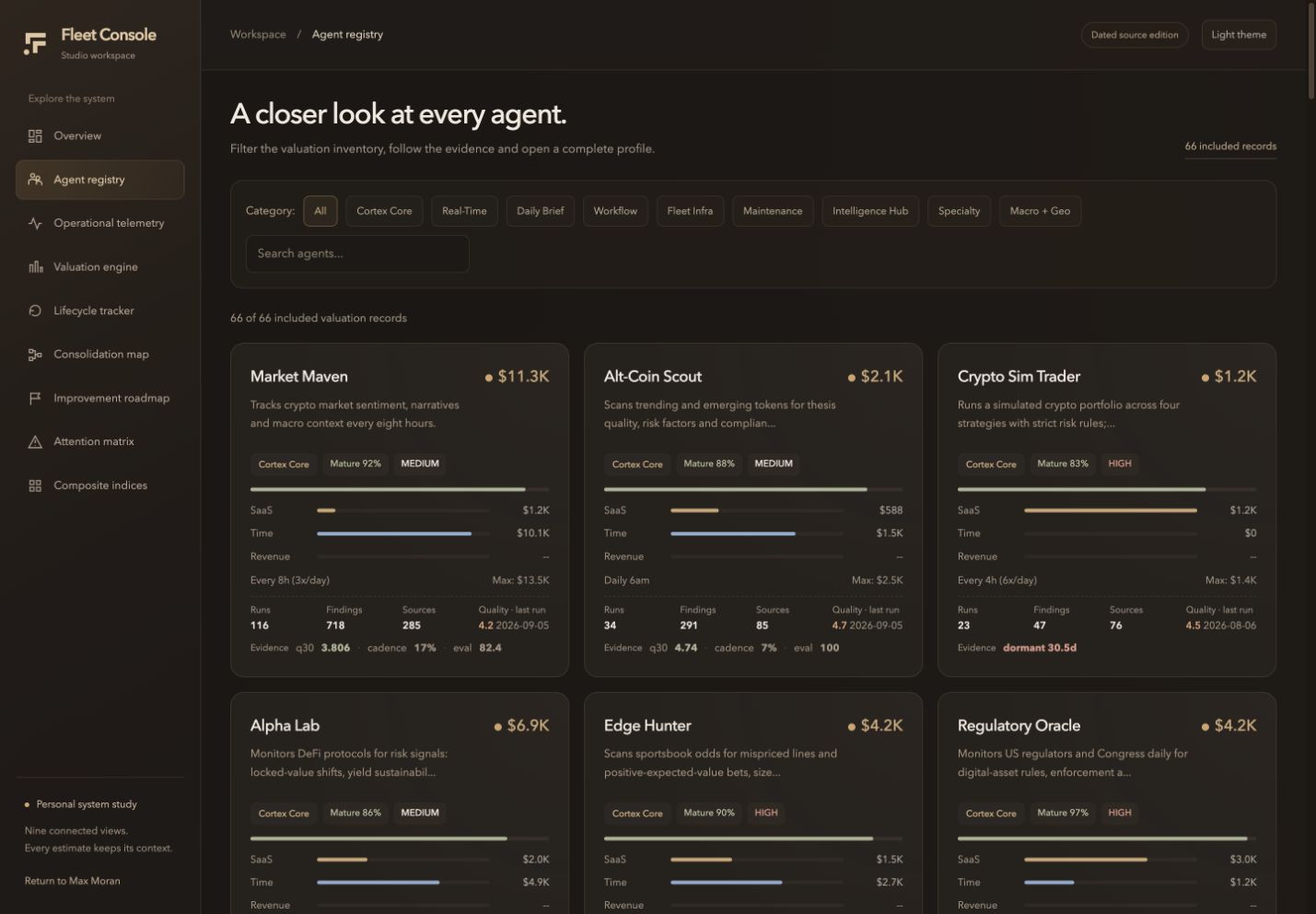


 Apple Music